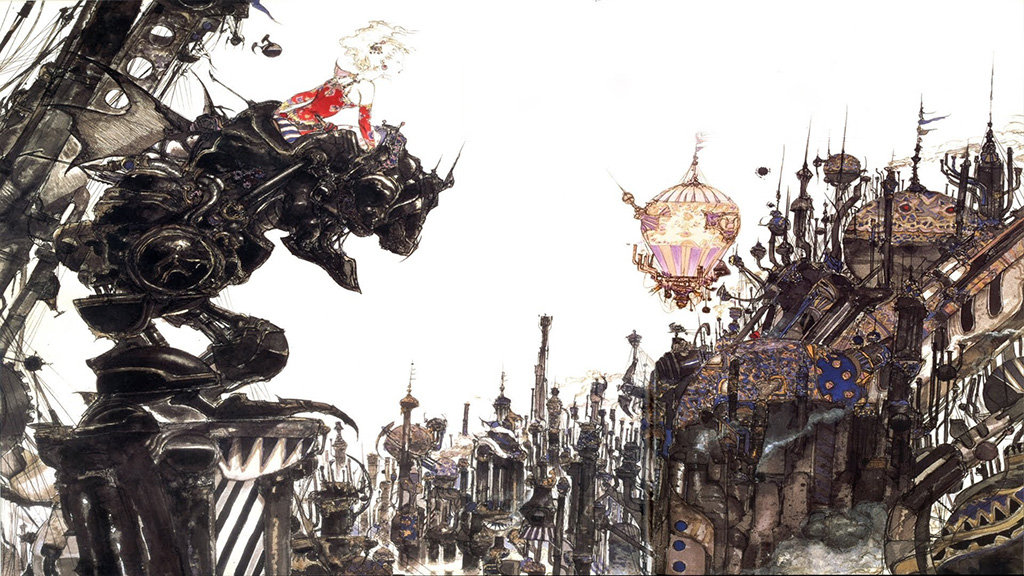
Terra and I
The Supreme Court ruling in U.S. v. Skrmetti comes shortly after the release of the Final Fantasy x Magic: The Gathering crossover set I’ve been enjoying. My mind’s swimming in thoughts blending this unlikely pairing.

It unexpectedly shook free an article I’ve been meaning to write for years about my favorite video game. Final Fantasy VI has been my favorite game since I first rented it from Blockbuster Video as a kid. It’s only grown more dear to me since.
This article is full of major spoilers that won’t do the full experience justice. I recommend playing it for yourself before reading this if you enjoy RPGs.
The best way to experience Final Fantasy VI is an original SNES cartridge in an SNES on a Tube TV.
Secondly, and far easier to access, is the official Pixel Remaster by Square Enix. (Steam) (Nintendo Switch)
My Favorite Characters of Final Fantasy VI
As a kid, when I first fell in love with Final Fantasy VI, my favorites were Locke, Shadow, and Sabin. I’ve replayed Final Fantasy VI dozens of times since and grown to appreciate most of the other named characters in the story, to the extent I could likely write in-universe fanfiction about any of them.
Ultros
When I hit my twenties I really loved Ultros, a unique misunderstood pest of a villain whose over-the-top bravado and accentuated toxicity were a misguided bid for acceptance from the other monsters he grew up surrounded by. This community likely modeled and rewarded him for terrorizing (or at least annoying) unsuspecting adventurers. He felt the need to perform villainy for acceptance until he met Relm, a young artist who truly saw his inner self and reflected what she saw back to him. She later accepted him as he was, once he dropped his facade.

She even began calling him “Uncle Ulty” by the end. While we never see him fully redeemed, he does seem changed to a more peaceful and thoughtful version of himself. This was where my head was at when I began using his name as my online moniker.
Terra


Since my thirties, it became increasingly difficult to ignore my inner child’s fists banging on the hard outer shell I’d constructed. Terra became my favorite Final Fantasy VI character. Now, whenever I start a new adventure, she bears my name — an honor previously held by Locke. Her story has resonated with my own experiences in ways which unfold more each time I replay the game.
Terra’s Story
Terra’s story arc is more complex than most video game protagonists (especially in 1994).
I’ll provide some unjustly vague distillations of her story before describing my interpretations and relation along the way.
Arc 1: Terra Awakens

- The Empire uses a brainwashed, amnesiac young woman as a weapon. Robbed of her free will by a slave crown, she only follows orders from two soldiers accompanying her.
- During a mission, she encounters an esper — a member of a race of ancient magical creatures. It annihilates the two soldiers and disrupts her slave crown, freeing her from its control.
- A member of The Returners, a rebel group fighting The Empire, finds her. She struggles to recover lost memories while they encourage her to aid in fighting her former enslavers.
M-M-M-Magic!?
Soon after Terra breaks free of the slave crown, monsters attack her and her new companions on the road to the neighboring city — an Empire-friendly castle called Figaro. During battle, she casts a Fire spell, only for Locke and Edgar to freak out.

While monsters are still attacking them, her new companions attempt to process what they just witnessed. Magic, a phenomenon they thought disappeared 1,000 years ago.
This is what it’s like to simply exist in a relaxed state and act the way I naturally do. I walk, talk, move, and solve problems the ways I feel most comfortable, only for others to occasionally and suddenly freak out. Often othering, pathologizing, or dehumanizing me in some way.
But no human is born with the power you have!

At this point in the story, Terra had no explanation for her powers, no matter how many people demanded answers. Many of whom actively pursued her in an effort to detain and exploit her further. Even her companions, who helped free her from that fate, show signs of treating her like an other or a tool within the first days meeting her.
This is where her and my stories diverge. While the people around Terra took her to see an elder who may understand her, I was bullied. I reacted by repressing things I learned (from abuse) might attract unwanted attention. Even something as simple as the way I walked was criticized and punished by other kids and sometimes even adults.
So I studied how “normal” boys acted and mimicked them to fit in with what was expected from me — including mischief and violence. Occasionally, and regretfully, I even joined the bullying side against other kids. All to attempt belonging to an in-group for a change.
I did it for so long I lost myself, forgetting it was a mask.
Returning to Herself

- Fragments of memories return sporadically as Terra flees The Empire alongside The Returners while considering their recruitment offer.
- She eventually joins them after they exhibit respect for her autonomy.
- They set out on a covert mission to revisit the esper who first broke Terra free. After fighting through Imperial forces, she encounters it once again.
- The esper reacts to her presence, and she begins to glow as an electrical force resonates between them. She transforms into a bright fearsome pink glowing version of herself, screams with an otherworldly shriek — which still startles me each time, though I know it’s coming — and tears into the sky flying across the globe.
- The rest of the party embarks on the next leg of their journey to find her. While the player witnesses this part of the story firsthand, off-screen Terra has landed in Zozo, an isolated downtrodden city.
- She meets Ramuh, another esper, who tells her she’s the child of Madeline, a human, and Maduin, an esper. Possibly the first of her kind.
While I can’t fly away, I’ve felt big emotional reactions from meeting other queer and neurodivergent people for the first time. I pestered them for details about their most personal feelings and experiences. I believed it to be innocent curiosity, only later realizing I was looking for breadcrumbs to follow. Some of these lovely people became friends. I look to them as elders, even if our ages aren’t much different.
Grappling With Childhood
In Final Fantasy VI, we see Terra’s first 18 years in sepia-toned flashbacks. This is often how it feels to look back on my life after discovering something new about myself. Experiences that just felt weird and uncomfortable at the time now have context. Many are painful, but understanding it sometimes reduces the pain.
In Terra’s flashbacks, we get a view of the adult figures who shaped her experience:
- Terra remembers little of her brief time with her biological parents. Emperor Gestahl kidnapped her when she was less than 2 years old, killed her mother, imprisoned her father in an Imperial facility, and syphoned his magic away.
- General Kefka only ever used her as a tool. Despite ignoring orders, he always seems to get his way. Even when confronted by the other generals, the Emperor’s inaction in stopping him shows tacit approval of his brutality.
- General Leo seems like a decent and competent man. He projects his own good faith and values onto his nation. It blinds him to what the Empire truly is.
- General Celes eventually defied the Emperor before we meet her, but she remembers Terra — or at least remembers her in her slave state.


While we’re young, we accept our environment as natural. We know no other way for things to be than how they are when we arrive. Especially when people hide anything outside from us.
Our Utility
Terra’s influences treated her as a weapon, so it’s no wonder she grew up completely disconnected from her emotions. Only a few months after breaking free, she learns about emotional connection from Locke and her other new companions. She openly wonders if she’ll ever feel love herself.
When we grow up in fallow soil in certain aspects of our development, we miss out on the modeling of healthy ways to feel, process, and express our emotions. These social structures starve or beat our sensitivities out of us so we can better serve the powerful. We often wonder if we’ll ever be able to heal, or if those parts of ourselves are permanently severed.
Arc 2: Terra Finds Her Balance
Given some time after learning about her identity, Terra begins to learn how to control her body’s two states: her human baseline and her Trance state.

Spurred by Ramuh’s final request before bestowing his power and those of his fallen comrades upon the team, Terra leads The Returners on the next mission. They must go to the Imperial capitol and free the captive espers being tortured there — their lives exploited so Emperor Gestahl can gather even more power.
I hope I don’t need to explain the current real world events this relates to.
The first step is re-opening the barrier between the esper and human worlds — sealed since Gestahl kidnapped Terra. The Returners fight — loosely aligned with the espers — against The Empire attempting to free them and stop Kefka’s genocide.
After freeing the espers, they witness what The Empire is doing to their kind and launch an enraged attack on the capitol. Once the attack passes, The Emperor raises a white flag and claims to want peace and compromise.
Thamasa
The Empire and The Returners join forces to investigate Thamasa, a remote village rumored to be inhabited by humans who can use magic. After initially being snubbed in suspicion, Terra, Celes, and their friends endear themselves to the secretive townspeople by rescuing their children from a burning building. The villagers feel compelled to use their magic to extinguish the fire, despite it revealing themselves to the outsiders.
After the rescue in Thamasa, the villagers help General Leo find where the espers are hiding in a nearby cave. He establishes a truce between the espers and The Empire. Kefka immediately takes advantage of this, wipes out the entire community of espers, and steals their power. General Leo, finally realizing he’s been a pawn in this plot, turns on Kefka who dispatches him with ease. Any hope Terra and Celes had for The Empire changing its ways dies with him.
After exterminating dozens of espers as they fight desperately to save their kin, Kefka learns about, finds, and activates The Warring Triad — three ancient gods who sealed themselves in place in a three-way stalemate that allows the world to exist in balance.

Fighting The Apocalypse
The earth shakes violently as a swathe the size of a small country tears loose and levitates into the sky. An alien plane full of mysterious biology and advanced technology that hasn’t been seen by humans in over 1,000 years bursts forth. And it’s in The Empire’s clutches.
After fighting through arduous terrain and powerful awoken monsters, The Returners find Kefka and Gestahl at its peak admiring The Warring Triad. While the Emperor seems content to possess the statues and their inherent power, Kefka takes the opportunity to betray him. Kefka kills the Emperor and moves the statues into chaotic uneven positions, disrupting the balance holding the world together.
As tends to happen when hateful, power-mad narcissists get what they want, the entire planet trembles and bursts at its seams. The heroes of our story failed, and the world falls apart.
But the story isn’t over.
Arc 3: Terra Starts Over
After Kefka twists and mostly destroys the world, Terra lands in Mobliz, a small village where nearly every adult has been killed or disappeared. Only a group of children remain, starving. She fell into a parental role for these children: protector, nurturer. And the feelings it stirred within her were powerful and confusing.

When her companions — who she’d thought died in the catastrophe — came looking for her, she no longer wanted to fight. She wanted to take care of her new found family. She found a role that better suits what she wants and a community where no one sees her as a weapon. Her friends accept her decision and leave her to it.
But then a powerful monster attacks her village. Terra tries her best to fight it off herself, but fails. Luckily, her friends rushed back when they saw the commotion and defended Mobliz to survive another day.
Terra once again loses hope. Feeling powerless to stop forces of evil who won’t stop attacking her loved ones, who just want to live peacefully. She asks her friends to leave her alone a while.
Arc 4: Terra Finds Her Strength
When we next return to Mobliz, Terra continues to grow into her role as a leader and nurturer. Upon entering one of the homes we discover one of the teenagers in the town is pregnant. While the complex repercussions of this development just begin to emerge, a monster attacks the village yet again.
For this battle Terra embraces her full self, her human and trance states working in harmony. With the help of her friends, she defeats the monster and realizes what she must now do.

This isn’t the end of the story, but it’s when Terra is simultaneously at her greatest strength and up against her greatest challenges.
This is where I am today.
The Supreme Court ruling strikes directly at my own childhood self. The one I fantasize about having, where I knew my differences didn’t mean I was broken. Where adults around me understood those differences. Where authority figures guided me toward becoming the person I am and not who they thought fit best into their ideologies. Not how I could be a better dehumanized cog in the imperial machine.
A few years ago, there was some hope for children like me entering puberty today. Improved counseling, sex education, and the mixed bag of the internet revealed the complexity and diversity of both orientation and gender expression. Awareness of gender non-conforming people existing is such an amazing gift. I often consider it when asked what one thing I’d tell my younger self if I could time travel.
Many left-handed parents today are grateful their kids don’t endure the same abusive physical punishment inflicted upon them. Perhaps kids like me might avoid much of the pain I endured and the permanent scars they inflicted.
For the Children
Terra, now aware that the children of today aren’t safe from the villains she barely survived, takes up arms and joins her comrades to do everything she can to make them safe.
This is why I protest. It’s why I’m running for local office. Despite how powerless I often feel, I must recognize small ways I can maybe make the world safer. I can use my unique talents and experience to guide better decision making. My path isn’t the same as the paths others take alongside me, who have different talents and resources. We all need each other to work toward dethroning the tyrants of our reality.

More Prescient Details of the World of Final Fantasy VI
More musings about my love for Final Fantasy VI, how horrified I am as the real world continues to mirror it, and how grateful I am for the heroic modeling its protagonists provide me.
The Death Cult

Defying belief, we discover people who actually worship Kefka and help him continue to pillage and terrorize the planet. These nihilistic followers dedicate their lives to stopping anyone who gets in Kefka’s way. They construct an enormous brutalist tower and surrender their entire lives to the mad despot. Kefka never acknowledges them, and may not even be aware they exist.
Once the cult leader of the tower falls, the remaining cultists mostly scatter. They blend back into whatever towns and villages they found themselves, presumably trying to forget what they did. Perhaps waiting for the next tyrant to rise.
Kefka’s Warped Esper Amalgum & Final Form

Kefka co-opts the form of the espers he exploits and destroys into a monstrous chimera of magical beasts and mutilated human figures.
This is what it feels like when I witness religions twisted to justify murder, war, genocide, and everything their true forms stand against. Megalomaniacal demagogues weaponize peaceful belief systems to warp their people into monsters with little awareness of what’s happened to them. Power and influence are intoxicating and contagious. Those starving for it will grasp at anything to have a taste.
Each of these sections are enormous, and taken for each step along the heroes’ ascent they’re incredibly intimidating. But when viewed as a whole after the battle ends, it appears dead and rotting. This is the pile of corpses Kefka stands atop to steal his position of power.

Kefka’s final form is enormous and angelic, bestowing upon himself the unearned trappings of purity and benevolence. He descends from the heavens for the final battle against the diverse rag-tag group who, despite their drastic differences and arguments along the way, stand united against him. They see through Kefka’s mighty appearance to the weak, petulant clown at his core and strike him down.
The Ending
The ending depicts the world after we strike Kefka down. The world isn’t magically restored to its original form. Nothing resurrects the billions who died like a wish on the Dragon Balls or Infinity Gauntlet. Small signs of life creep slowly back between the cracks in it like plants between sidewalk tiles. The sun rises in the still-blood-red sky.
We will never get back most of what this tyrant and his sycophantic cultists took from us. But we can find ways to slow him down and reduce those harms. We’ll eventually see glimpses of a future less dim than the present. If we’re lucky, if we band together, find what strength we have, and use it while we can.